In the latest edition of her weekly e-mail message, the Executive Director of the Theatre Communications Group, Teresa Eyring, raised questions about President Obama’s educational reform programs, noting growing concern about the Administration’s narrow focus on math, science, testing and accountability.
Ms. Eyring’s post included a link to a letter that the National Council of the Churches of Christ in the USA sent to the President. (The group claims to represent 36 Christian communions with a combined membership of 45 million persons in more than 100,000 congregations across the nation; i.e., a lot of Christians).
The letter began by stating the group's common conviction “that the church is called to speak for justice in public education.” It went on to affirm “that our society’s provision of public education—publicly funded, universally available, and accountable to the public—while imperfect, is essential for ensuring that all children are served.”
Despite the prevailing theological tone, these folks make damned good sense. God bless 'em. You can read the entire letter if you want, or you can save time by letting me excerpt the important sections. The first statement is what caught my attention and had me saying, "Yeah! Right on!"
We reject the language of business for discussing public education.
Not only has the language of the marketplace entered discussions of school governance and management, but we also notice that the language of business accountability is used to talk about education, a human endeavor of caring...We worry that our society has come to view what is good as what can be measured and compared... The relentless focus on testing basic skills has diminished our attention to the humanities, the social studies, the arts, and child and adolescent development. We value public school educators.
Our biblical heritage and our theology teach us that we live in community, not solely in the marketplace. As we strive to move our imperfect world closer to the realm of God, we recognize that we are all responsible for making sure that public schools, as primary civic institutions, embody our love for one another. We are called to create institutions that serve families and children with hospitality. We are called to work as citizens for the resources that will support a climate of trust and community within each public school. We are also called to value those whose vocation is teaching...Wholesale scapegoating of public school teachers is an ugly and unfortunate development in federal policy.
Full Disclosure: I am the product of the public education system. I am also the product of parents who were educators in public schools. Also, my grandmother was an educator. My sister too. Oh, friends as well.
Super-talented artist and political activist Mel Chin is bringing his Fundred Dollar Bill Project to Portland this Friday, May 12 at 12:30pm.
The Fundred Dollar Bill is a national project that is engaging 3 million kids across the country. Kids draw original interpretations of the US $100 bill, and a veggie-oil powered armored truck arrives to pick them up. The truck will drive across the country and end in Washington DC, where Mel will request that Congress exchange the Fundreds for real funding to detoxify lead polluted soil in New Orleans.
How cool is that?
Free and Open to All Ages
St Mary's Academy
1615 Southwest 5th Avenue in Portland Friday, May 12 at 12:30pm. www.stmaryspdx.org
Has Culture Shock given you more arts advocacy than you need or want? Are your gullets glutted with our pro-arts sentiments?
Perhaps you're already sold on the notion that arts and culture are societal salves --balms to cure economic catastrophe, reverse rampant underachievement, and assuage the anomie of the aimless. If so, our relentless advocacy may smack of beating a horse that already drank the Kool-Aid.
Or, heavens forfend, some of you may not be buying it at all. You've heard all the arguments in favor of the arts and all you can say is "pish posh" and "pizzletwist." For you, the arts are nothing more than a shiny charm bracelet--a little gris-gris stuffed in a juju sack to make us feel better. Or you think the arts are elitist and unable to survive in the rustle-tussle of the marketplace. "The fat lady has sung, " you declare. Enough said. Period. End of story.
To every one of our dear readers, it's my duty to tell you that we're duty bound to be hidebound on this issue. What would you have us do? Throw up our hands and throw in the towel?
Every once in a while, somebody famous says smart things about the arts that are ... well ... more eloquent than anything we can say. Rachel Maddow, for instance. That MSNBC pundit says smart things all the time--about all kinds of issues. She recently spoke at Jacob's Pillow, the annual contemporary dance festival in the Berkshires, and shared this brilliance with the audience:
Sometimes we choose to serve our country in uniform, in war. Sometimes in elected office. And those are the ways of serving our country that I think we are trained to easily call heroic.
It’s also a service to your country, I think, to teach poetry in the prisons, to be an incredibly dedicated student of dance, to fight for funding music and arts education in the schools. A country without an expectation of minimal artistic literacy, without a basic structure by which the artists among us can be awakened and given the choice of following their talents and a way to get to be great at what they do, is a country that is not actually as great as it could be.
And a country without the capacity to nurture artistic greatness is not being a great country. It is a service to our country, and sometimes it is heroic service to our country, to fight for the United States of America to have the capacity to nurture artistic greatness.
Not just in wartime but especially in wartime, and not just in hard economic times but especially in hard economic times, the arts get dismissed as ‘sissy’. Dance gets dismissed as craft, creativity gets dismissed as inessential, to the detriment of our country. And so when we fight for dance, when we buy art that’s made by living American artists, when we say that even when you cut education to the bone, you do not cut arts and music education, because arts and music education IS bone, it is structural, it is essential; you are--in [Jacob’s Pillow founder] Ted Shawn’s words--you are preserving the way of life that we are supposedly fighting for and it’s worth being proud of.”
Though Maddow's statement is spreading on the interwebs, I credit the website Dancing Perfectly Free as the first place I spotted it. The photo is by Christopher Duggan.
As I mentioned briefly in my dispatch from the Oregon Arts Summit, Oregon poet Kim Stafford has penned a new "Declaration of Creative Rights" on behalf of the Oregon Arts Commission. His text synthesizes a great deal of input from Oregon's citizens articulating the belief that arts education is vitally important to all of us. Among other things, the Declaration is being used by the OAC to launch a new statewide arts education planning effort, which you can learn more about by visiting www.oregonartseducationcongress.org.
Here's the declaration itself, which Stafford says he modeled after Thomas Jefferson's famous document of 1776, "complete with long sentences and capricious capitalization."
In Oregon, May, 2009 The Declaration of the Myriad Oregon Friends of the Young
When in the Life of an Oregon Child it becomes necessary to advance beyond Reticence, beyond a lapse in Personal Vision, or a loss of Innate Genius resident in the growing Mind, and to assume among the Powers of the Earth that confident station to which the process of Discovery shall entitle each Young Citizen, a respect for the Benefit of all Oregonians requires that we declare Certain Principles of learning that impel this Life.
We hold early Creative Experience to be indelible, and that all children need be offered, equally and abundantly, certain Rights that secure access to the formative Encounters of Art-and that among these are making original Work, savoring creative Practice, and the Pursuit of one's own generous Vision and articulate Voice.
To secure these Creative Rights for the young, art programs are instituted in schools and communities, deriving their just Purpose from the needs of our People. Whenever our ways with the Young become destructive of these creative experiences, it is the Obligation of the People of Oregon to lay a New Foundation, as it may seem to them Expedient, in order to effect our people's Safety and Happiness.
At every Stage of our state's history we have recognized the power of creative citizens to encounter, to consider, and in Good Company one with another to resolve by Insight, Wisdom, and Work together any difficulty that may confront us. And just as a River, in order to thrive in passage through the Tangle of Civilization, must begin pure at its source of Oregon Origin-Applegate, Rogue, Umpqua, McKenzie, Santiam, Chetco, Siuslaw, Trask, Deschutes, Malheur, Grande Ronde, Wallowa-so must a Child begin with pure encounter in the Ways of the Maker, the Inventor, the Architect of personal Image, Craft, Hue, Print, Dance, Drama, Song, and Story.
Therefore, Friends to the Children of Oregon, and Friends to the inventive Capacity that will be required of our people in Difficult and Dangerous Times, we here appeal to all Families, Schools, and Communities to adopt certain Creative Rights for each young Scholar of the Possible. We hold it only just, that each child be afforded these early and frequent Experiences in Creation, that our state may thrive. We thus Publish and Declare that each child is, and by right ought to be, free to advance our common cause through access to Art. For the support of this Declaration, we mutually Pledge to each other, and to the Children of Oregon, our Lives, our Fortunes, and our Honor.
--Kim Stafford
Meanwhile, on a somewhat related note:
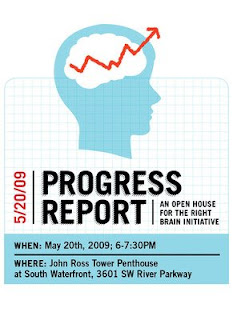
If you are wondering how that grand experiment known as The Right Brain Initiative is coming along, then consider this your hand-engraved invitation to attend an Open House on Wednesday evening at the John Ross Tower Penthouse in South Waterfront. (Sweet!) It's billed as a Progress Report of sorts, and from 6PM to 7:30, you can see a sampling of student work and hear stories about what’s possible when artists, arts organizations, teachers, schools, and the community collaborate in the name of whole-brain education.
Like all good sons, I owe a debt of gratitude to my mother, and not just for the labor pains and other aches of motherhood. My mother can be credited (or blamed), in large part, for instilling in me an appreciation of culture and the arts.
She, who would recite, “Out, damn’d spot, out I say!” when she washed her hands at the kitchen sink is responsible for my theater-loving ways. She passed that interest along to her grandkids as well. Whenever the clutch of cousins gathered at their grandparent's house, they would disappear for hours to write and rehearse plays, select costumes from a treasure trove of gowns, wigs and cheap jewelry, draw up playbills and gather the family in the living room for the premiere. Afterwards, grandma would type and bind the scripts as souvenirs. Now in her eighties, my mother plies the acting trade as a living history interpreter at the Empire Mine, a California state park in Grass Valley. As a volunteer, she routinely dons period costumes to play the part of either the cook at the Bourn Mansion or the secretary in the mine office. For literature fans, a thinly fictionalized version of the neighboring North Star Mine plays a part in Wallace Stegner’s brilliant novel, “The Angle of Repose.” In the novel, the name of the North Star House is changed to the "Zodiac House."
My mother instilled a love of word play in me. On long road trips, we’d play the guessing game that starts, “I’m thinking of a word …” or another called “Hinky Pinky.” Give my mother a word puzzle too close to bedtime and it’s as good as a double shot of espresso for keeping her from sleep for hours.
Both of my parents are long-time public library boosters. Thanks to them, not having a library card in my wallet is as unthinkable as not having a driver’s license. Coming home with an armful of books is a pleasure introduced when I was just a tyke.
A few years ago, the Nevada County Library Foundation published an anthology of essays and poems titled, “Open to All: What the Library Means to Me.” My mother contributed several poems to that edition, which also includes an essay by another Nevada County resident and poet, Gary Snyder. In honor of Mother's Day, here are four of my mother's poems about libraries:
First Library Visit
“My, little girl, you are certainly checking out a lot of books.”
“I know, but I have to get started. I’m going to read every book here.”
Seventy years later Countless libraries behind me Goal not realized Still checking out a lot of books.
My Life, A Moving Experience
Readers who move often Don’t buy books. New town, vital question, “Where’s the library?”
On Returning Books to the Library
Go directly to the return table. Return books. Resist lure of siren songs from stacks. Remember, he is double parked.
Apology to Booksellers
A friend recommends a good read. My response, “Sounds great. I’ll check it out at the Library.”
When my mother gave her kids and grandkids copies of the anthology, she included a bookmark with this inscription:
Confession and Abdication
To my children and grandchildren, I confess my limitations. Seventy years after my first library visit I admit I cannot read all the books in print. Please take over and finish the job!
Correction: Count on Mom to point out the mistakes, which I've now edited. In my original post, I misspelled "Bourn" and placed the "The Angle of Repose" at the Empire Mine, rather than the neighboring North Star Mine. The architect for the North Star House was Julia Morgan --best known for her work on Hearst Castle, William Randolph Hearst's extravagant mansion at San Simeon. My parents have been involved in efforts to preserve the North Star House, which was quickly deteriorating, covered in graffiti and on the verge of being bulldozed. I guess I need to give my folks credit for an interest in historic preservation too.
It's way too nice outside, which, as Mighty Toy Cannon points out, makes it hard to attend an indoor arts event. I confess that I didn't make it through most of my arts itinerary before the great outdoors lured me in other directions; you have to seize these weekends when they happen, and we all know that there will be plenty more rain between now and the 4th of July. But I did enjoy an impromptu game of Red Dress Bingo on Sunday night, sponsored by the Sisters of Perpetual Indulgence as a benefit for the Red Dress Party, before hosting a late night backyard barbecue for all those who worked through the weekend to build "Red Eye" in the Bodyvox Dance Studio.
It's also too hot to be inside my office, so I need to go outside soon. Seriously, between the sun beating on these large windows and the air conditioning's inability to keep up, it's 83 degrees in here, and that's just not comfortable no matter how much water I drink. Time to take the laptop to the park.
Summer's imminence also has me thinking about summer camp. At our house that might mean boot camp for Taylor, but you might be more inclined to send your own child (or someone else's) to an arts-related experience. Here's an online listing of summer arts camps for kids to help get you organized now before they fill up.
Those of us who are involved in arts education often press the argument that early participation in the arts is an essential part of a whole education. When a young child experiences his or her first live performance, indelible memories are created. The experience may even influence the paths that child will follow all through life. Here’s just one example of a memorable arts experience:
This morning, I received an insider tip that conservative commentator Lars Larson was preparing to skewer Stan Foote, Artistic Director of Oregon Children’s Theatre (OCT), on his KXL radio show. Mr. Larson’s staff had apparently spotted an incendiary OCT press release about its upcoming show, Click, Clack, Moo: Cows that Type, which included the following teaser: "The book is widely used and supported by unions as it promotes their message of organizing, empowerment, and solidarity. Lawyers of labor and employment law also recommend this book."
Now if you’ve ever listened to Larson’s radio show, you'll know that he has a beef (no pun intended...yes it was) with labor unions, particularly now that union workers have single-handedly destroyed the American auto industry. (Also, he doesn't like the illegal immigrants so much). So you can imagine his consternation upon learning that the region’s flagship theater for young audiences was propagandizing for the union cause. To Larson’s credit, he invited Foote to speak on the air about this pressing issue, rather than just trash talking about it.
Background: Click, Clack, Moo is a popular picture book by Doreen Cronin, with delightful illustrations by Betsy Lewin. It was awarded the prestigious Caldecott Honor in 2001, and named Best Children's Book by Publishers Weekly in 2000.
The plot of the slim volume is simple: The farm animals are cold. Banding together, they use a typewriter they have found to type a note asking Farmer Brown for electric blankets. When Farmer Brown ignores their repeated requests, the animals refuse to produce eggs and milk--in other words, they strike. Outraged, Farmer Brown sends his response: “There will be no electric blankets. You are cows and hens. I demand milk and eggs.”
The labor/management impasse is resolved when the farm animals offer to exchange their typewriter for electric blankets. Farmer Brown decides this a fair exchange and everyone gets what they want.
That’s the long and short of it. The stage adaptation expands on the book with a little extra back story and fun song and dance numbers (including an homage to Les Miz). Larson’s concern is that children watching the play will be unwittingly indoctrinated to believe that unions and collective bargaining are good for society. Paraphrasing, here are a few of the questions he posed in his interview this afternoon:
Aren't the animals making demands that will drive the poor farmer into bankruptcy? How is this any different than union autoworkers forcing GM out of business by making unreasonable demands for outrageous wages and benefits?
Should we be encouraging school kids to make demands? What if they ask for more recess? Are we supposed to just give them what they want?
Isn't using subtle messages to teach unsuspecting children that unionism is good a lot like a madrassa teaching Palestinian children that Jews are dogs that ought to be put in the ovens?
Would OCT ever consider producing a play that espouses conservative values? For example, teaching children that every life--even that of the unborn--has value.
To summarize: (1) Unions = Bad; (2) Culture = Liberal Bias.
Foote responded with equanimity (though with a chuckle of incredulity through most of the interview). I know he's not a fan of heavy-handed “message” plays – he’d much rather give kids something to think and talk about than to spoon-feed them a particular viewpoint, left or right. Click, Clack, Moo, does have a few lessons about the value of communication, negotiation, compromise and -- brace yourself -- standing up for your rights. Are those really such bad things to be teaching children? And while the conclusion is that the cows, chickens and ducks get something in return for their militancy, they also give something up in return – in other words, everybody wins. By the way, did I mention that this play has tap-dancing cows in tutus?
As for the liberal bias, Foote informed Larson that OCT’s production (2005-06 season) of Lois Lowry’s powerful book, The Giver, told the harrowing story of a purportedly utopian society in which one approach to reaching “perfection” was to euthanize "imperfect" children. Foote pointed out that the play’s subtext spoke to the importance of individualism and the value of human life--sentiments that Larson seemed to appreciate. Of course, The Giver also questions how much freedom should a society be willing to sacrifice in exchange for security; it doesn't answer that question, but challenges young readers to think hard about an important, and very real issue.
I think Larson was mostly looking to pick a fight to make a point about unions and how the conservative viewpoint never gets a fighting chance in our culture. Thankfully, he did not try to drum up listener outrage, nor did he issue the right wing equivalent of a fatwah against OCT. He also refrained from personally disparaging or belittling his interviewee--a tactic that seems all too common with his ilk. He even let Foote conclude the interview by offering a $3.00 discount on tickets to Click, Clack, Moo for anyone calling the OCT box office (503-228-9571) and saying “Lars sent me.” I’ll let you know if I hear of any takers.
Final note: OCT asked a talented member of its Young Professionals program, Fergus Firth, to produce a few promotional videos for Click, Clack, Moo. Fergus recently appeared in OCT’s production of Gossamer, playing the lovable dog, Toby. He also played the Prince for a few years in OBT’s production of The Nutcracker. What else? He's produced award-winning films with NW Film Center, and composed a piece performed by Fear No Music as part of its Young Composers program (which you can listen to here). This young man is an example of just how dangerous arts education can be.
Below is his video snippet of early rehearsals for Click, Clack, Moo to give you a better feel for how dangerously radical it's going to be.
Figure 1: Let's look into our crystal ball, shall we?
Figure 2: The Crystal Ballroom, site of the Portland Jazz Orchestra's upcoming “Intricate Rhythms," one of 102 projects receiving funding for 2009.
While our friends at Art Scatter were shaking the money tree last Wednesday, the RACC Board was quietly approving record sums of grant funding for artistic projects in 2009. Now that artists and organizations have had time to receive their award letters (and rejections), I'm giddy to help announce the winners.
Actually, let me just link you to the full description of all projects that have received awards for the year ahead. This is one story that actually gets a fair amount of attention each year, as the media and bloggers have fun picking out the projects they are most excited to see. What's your favorite?
Two themes are especially noteworthy here, in my opinion. First, how many of these project grants would you guess are going to the "same old" groups vs. first-time winners? Would you believe 50-50? It's true.
Secondly, this is the most money ever awarded by RACC for project grants, and while the recipient artists and organizations have plenty to cheer about, I suspect it will trigger a few critical remarks from folks who think this a frivolous investment amidst serious economic woes. You'll notice that the press release was written to counter any such sentiment, but we as an arts community must be sure to respond swiftly and intelligently to any Letter to the Editor or other public document that ridicules these investments or calls for arts funding cuts. It's time to gear up for the spring budget cycle, and we have much work to do to maintain arts funding locally as well as renewing statewide arts funding, including the Oregon Cultural Trust, for the next biennium as well.
To follow up on an old post that's fallen off the front page, The Right Brain Initiative has finally made its animated video available online at www.therightbraininitiative.org. It took a while for the design firm North to secure all of the copyright clearances for every image that's used in this video. I never really think about this much, but it's a big business selling stock photos and quality graphics (Getty Images charges several hundred to several thousand dollars for a single photo), and some of the original video aired at the rollout event last month included some, ahem, "borrowed" images. But all of the graphic elements have since been replaced with images available through Creative Commons affiliates such as Flickr. You'll see credits at the end of the piece for many of the images that were used in accordance with their free licensing agreement.
But enough from me. Check out the video.
Other versions will soon be available on You Tube and other streaming video providers so that sites and blogs (like this one) can embed the actual video into their content.
 Two things I try to avoid in my blog posts:


 Like all good sons, I owe a debt of gratitude to my mother, and not just for the labor pains and other aches of motherhood. My mother can be credited (or blamed), in large part, for instilling in me an appreciation of culture and the arts.


 Posts
Posts


